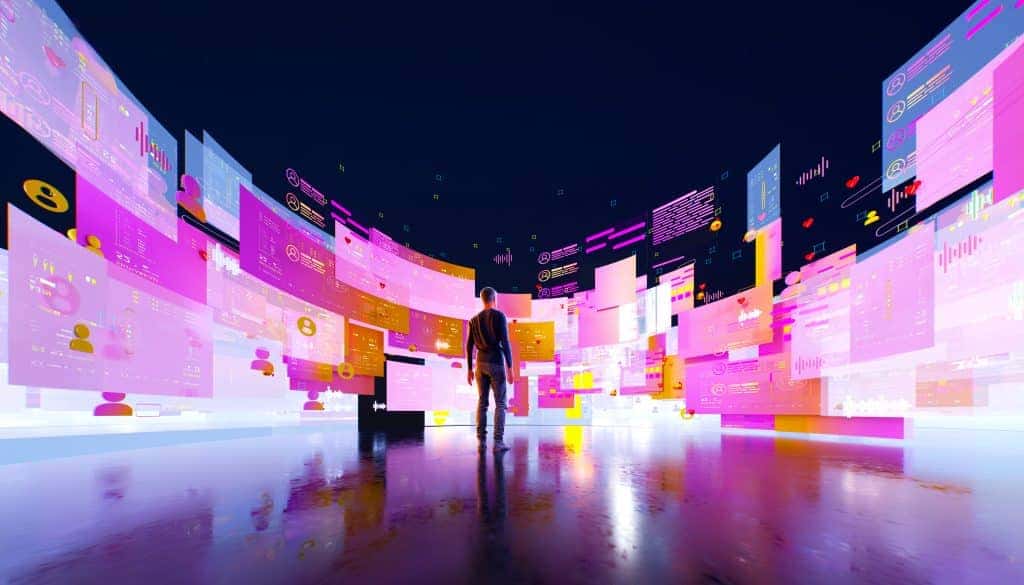
What is the fastest adopted technology in history? WhatsApp maybe? Well, it used to be, but that honor now belongs to ChatGPT.
Maybe this will not be such a surprise if you follow the news media, which is totally obsessed by the technology. Wherever you look, AI is going to save the world or destroy it. Create jobs or kill them. Either way, it seems things will never be the same.
As an academic with a focus on innovation, the current place we’re in with regard to AI and other technologies truly fascinates me. And that’s because nobody knows the extent to which AI applications can disrupt an industry like hospitality. Could these innovations become as fundamental as the rise of Airbnb or the OTAs like booking.com?
There’s plenty of signal and noise, to be sure. But the vital point to understand is that AI is an enabler, a platform, not a solution in and of itself.
The ability of AI to absorb and synthesize vast quantities of information is already being used to pick off what I’d call ‘low hanging fruit’ – for example refining marketing campaigns or optimizing processes. And we are seeing some fun innovations such as chefs using AI to come up with new recipes. But we have to be careful to make the separation between gimmicks and genuine steps forward for the industry.
The recombination promise
Can AI actually drive genuine, blue-sky innovation? After all, at the heart of the technology lies nothing more than an agglomeration of existing data and knowledge. This is a very important question, and when I ponder it my thoughts turn to arguably the ‘father of innovation’, the Austrian economist Joseph Schumpeter, who defined innovation as the recombination of existing resources and knowledge.
To give an example, think about the smartphone, and how excited we all were when it suddenly incorporated a digital camera. That was innovation through recombination – the mobile phone companies simply adopted a technology from the makers of digital cameras. If we think in those terms, could AI have the capacity to innovate through recombination?
In principle this is perfectly possible, thanks to the vast amount of knowledge and data AI models can access – and we have seen great experimentation in fields such as pharma, where AI has generated advanced new drugs recombining molecules. However, at present, and especially in sectors where the user experience is crucial, the technology is not sufficiently advanced to add the necessary layer of ‘human intuition’, which is often the result of tacit and non-codified knowledge, that would enable it to recombine knowledge in a way that produces a genuinely game-changing innovation.
And that’s why I think the human element remains an essential component of the innovation process to generate a valuable output. Regardless of the many kinds of cooperations humans and AI can have, the key message is: let’s use AI for its benefits as a tool, while acknowledging its limitations.
As an example from my field, academia, we have unfortunately seen an explosion of fully AI-generated essays and dissertations across the higher education sector. The problem is that these are often sub-optimal in terms of quality and very easy to spot due to deficiencies innate to AI, such as giving citations of articles that don’t exist, etc.
It’s an issue in business, too. One of the more high profile examples to break recently involved Deloitte Australia, which received a massive fine for submitting a report found to contain AI-generated errors.
For managers, there are clear pitfalls from an overly AI-reliant approach. If this technology is being deployed by one of your people to do a specific task and it produces an error, who is ultimately accountable for that error? The bot or the human controlling it? There are serious uncertainties from a managerial standpoint which need to be addressed before we can exploit this technology with full confidence.
These are the reasons why it is becoming increasingly important to train people, from students to collaborators, to promote a wise and proper use of AI and Large Language Models (LLMs).
Let me just conclude by mentioning that this is the current situation, but the technology itself is evolving and improving at a rapid pace. It would not surprise me if I have to reconsider some of what I’ve said in the near future.
Other innovation streams in hospitality
Of course, AI is the hot innovation story right now. But we should not overlook the many other interesting advances coming out of the hospitality sector. I have identified four primary drivers for these: labor shortage, sustainability, personalization/customization, and new business models.
The first driver around labor shortages will be well known to anyone involved with the hospitality industry. In a nutshell, during the pandemic hospitality businesses were forced to close in many markets, driving employees to different sectors, from which many did not return.
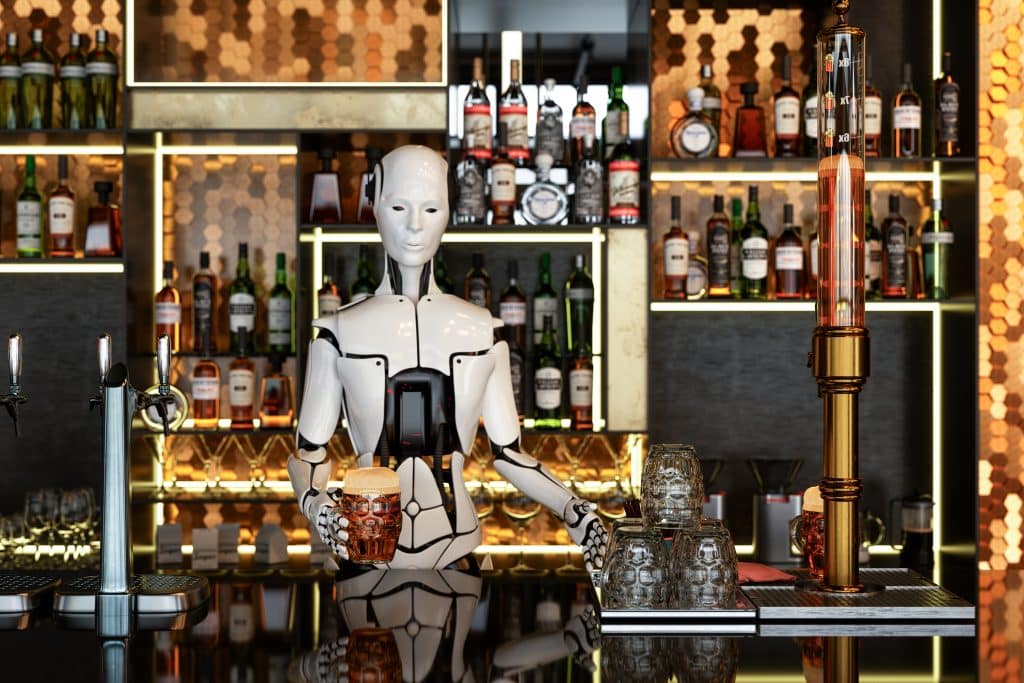
That shortage of labor has driven a surge of innovation in areas such as process optimization and adopting technology to substitute for humans when it comes to repetitive tasks. Here we are still very much in the experimentation stage – whether it’s robot bartenders (see above) or fully automated check-in – and it will take some time before the precise direction the industry takes in these areas becomes clear.
The second major driver is sustainability. This covers the full lifecycle of the hotel, from construction materials to energy saving throughout the building to local sourcing of ingredients in the restaurants. Here I wouldn’t say we are seeing anything radical from the hospitality industry; it’s more a case of adopting good practices from other industries and also responding to the ‘green’ sensitivities of guests. That said, we are seeing some interesting experimentation with using data management and data tracking to direct customers away from the main destinations in peak seasons toward ‘off beaten path’ locations or to low season periods.
The third major innovation driver is the increasing customization of the guest offer. As in all sectors, the typical hotel guest now demands a much greater degree of personalization, as well as a constant supply of new and fresh experiences with which they can impress their friends on social media.
We now find hotel operators carving up their niche to satisfy specific needs and customer groupings. For example, some luxury hotels are targeting families instead of focusing only on couples, while maintaining their exclusivity and luxury ethos. There is potentially no limit to hyper personalization, assuming it is economically viable, and AI is becoming an interesting tool to support this process throughout the customer journey.
The fourth and final of today’s primary innovation drivers relates to new business models. And here we are witnessing some genuinely innovative concepts, such as the all you can stay hotel pass. Perhaps inspired by the success of Airbnb, we find plenty of entrepreneurs being attracted to the hospitality sector. Again, the task will be to sift through these innovations and find those that can be scaled up as opposed to those which are really not much more than marketing campaigns.
It is important to note that these drivers are often interrelated with each other; for instance, sustainability might push towards new business models, and that AI and digitalization often play a crucial role as enablers of new paradigms.
Looking to the longer term, as with AI adoption it remains to be seen which of these various innovations will have a lasting impact. But the fact that so many new things are being tried at present says much about the fertile environment to be found in the hospitality sector.
Barriers to innovation adoption
In my experience, the principal barrier to a company’s ability to innovate is inertia. “We’ve always done things this way, why should we change?”.
It’s the manager’s greatest dilemma – he or she may be completely sold on the benefits of (or existential need for) a particular innovation, but how to permeate this throughout the organization?
When I’m lecturing students on this topic, I tend to fall back on one of the more famous case studies, that of Kodak. The company saw the ‘digital train’ coming – and indeed was actually the inventor of the digital camera – but due to its core competencies becoming core rigidities, it failed to adapt to the completely new marketplace and filed for bankruptcy in 2012.
Of course, the larger and more established a company is, the more this inertia tends to have set in. One of the most successful ways to counter this is by partnering with startups, to enable the business to explore new domains while maintaining sufficient focus on the existing business.
Another way is to ‘import’ innovation through acquisition. This is something we’ve seen in hospitality, with major multinational organizations such as Accor and Marriott International buying into fresh segments by acquiring groundbreaking brands such as Mama Shelter, citizenM, and others.
This latter approach carries risks of its own, in that absorption of a startup business into the corporate fold can simply quash the innovative and independent thinking that was its recipe for success in the first place.
Here a good model to follow is that of the Walt Disney Co. and its acquisition of Pixar in 2006. The latter had established a reputation for truly innovative filmmaking, which many feared would be lost once it was subsumed into the Disney behemoth. However, Disney has been careful to keep Pixar at arm’s length, enabling it to keep up its conveyor belt of great movies for the past two decades.
Don't overlook the human element

Amid the thirst for all things new, it is crucial not to overlook the core characteristic of hospitality: that it is the quintessential ‘human’ business. Much of the innovation I’ve talked about is in the realm of the tangible, but in hospitality success has as much to do with the intangible: how humans interact with each other and the psychological reactions this generates.
I see this as the great research opportunity in this sector; how to factor in the human element to supplement the more traditional academic research variables like space and time.
It's a big, big challenge, because it means adding these intangible elements to our existing research tools such as structural equation modeling (SEM) and suchlike. How do you quantify a feeling? How do you measure that moment when a fragrance in a hotel triggers a happy memory? Here is where scientists from different fields, for example innovation and psychology, find interesting collaborations and research questions to explore.
For hospitality academics and researchers, as well as for the industry itself, the future is very much one of innovation and exploration!
About the author
An entrepreneur turned scholar, Alessio Delpero founded and managed companies in the sport and hospitality sectors before entering the world of academia. His research activities explore how firms recombine knowledge to innovate, with a specific emphasis on how digital technologies – especially AI – shape creativity and innovation at individual and organizational levels. Alessio holds a PhD in Business Administration and Management from Bocconi University, where he also taught before joining Glion.
Photo credits
Main image: Andriy Onufriyenko/Getty
Happiness: Maskot/Getty
Robot bartender: Onurdongel/Getty