

As anyone who has worked for a service firm will testify, ‘customer first’ strategies are commonplace. But concretely, how can service firms truly put the customer first? And how do they create the optimal conditions to allow customers to draw value from their interactions with the firm?
A new research paper co-authored by Glion’s Mikèle Landry and fellow academic Olivier Furrer (Chaired Professor of Marketing at the University of Fribourg, Switzerland) explores the concept of value co-creation, in which both sides of the brand-customer relationship contribute to value outcomes.
“Co-creation is not a new concept, but uncovering what enables it sits at the heart of our paper,” Mikèle explains. “It argues against the idea that a brand creates value on its own and calls for a more thorough consideration of the benefits that the customer perceives from the service interaction, whether that’s an emotional connection, a sense of wellbeing, or self-actualization, among other experienced outcomes.
“This takes us a step beyond the more functional needs satisfied by the service interactions, because these alone do not recognize the agency the customer has in the relationship.”
Published in the prestigious Journal of Service Management, the paper features substantial theoretical and empirical reasoning, as well as being exceptionally comprehensive in its sources, drawing as it does on data from higher education and employment services.
Notably using the Service-dominant Orientation model (Karpen et al., 2015), the authors subjected their acquired data to a series of different analytical models, combining partial least squares structural equation modeling (PLS-SEM), finite mixture partial least squares (FIMIX-PLS) analysis and fuzzy set qualitative comparative analysis (fsQCA). Each process revealed new evidence – for example, the fsQCA results demonstrated how different configurations of interactional capabilities result in value co-creation or value no-creation.
All that means there’s plenty to chew on for academics. Equally, for service managers there is practical and actionable advice in terms of building customer-facing capabilities that will stimulate value co-creation.
Six enablers of service interactions
These ‘interactional capabilities’ can be understood as bringing to life the service interactions that customers experience. The paper demonstrates how these capabilities can be deployed in different combinations according to varying customer profiles, as highlighted by the authors:
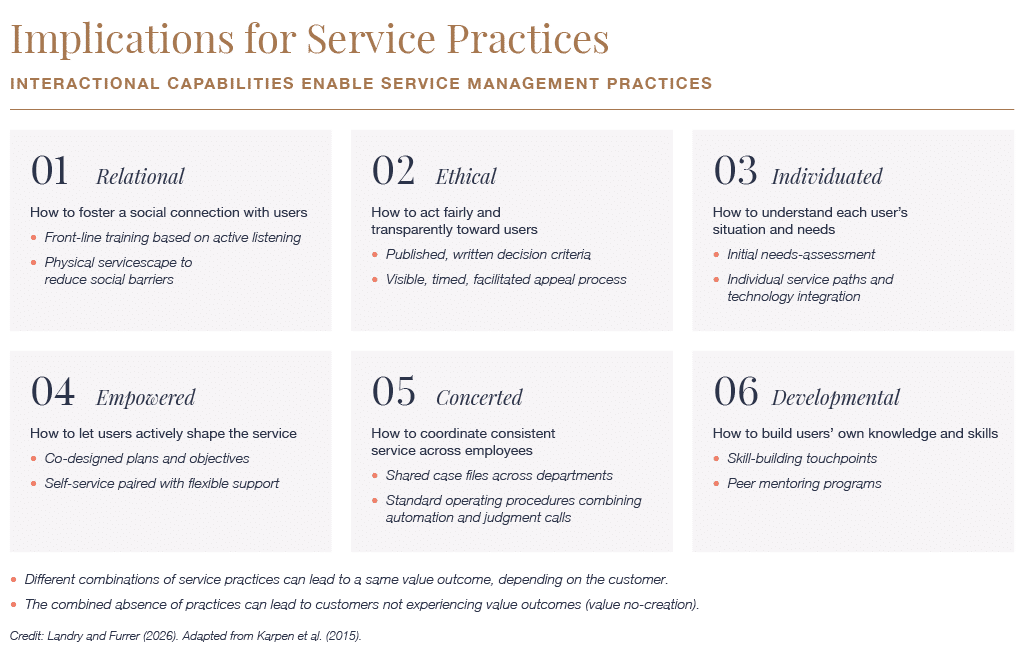
“We constructed our rationale around a framework that already exists (Karpen et al., 2015), and which is called the ‘service-dominant orientation’. For a service firm, adopting such an orientation means developing and leveraging a portfolio of interactional capabilities to co-create value with its customers through service interactions. As such, these six interactional capabilities, namely relational, ethical, individuated, empowered, concerted, and developmental capabilities, are the enablers for such a value co-creation approach,” Mikèle continues.
“If we look at just one capability as an example that is about empowering customers, this relates to giving the customers a say in how they want to structure their interactions with the brand. To achieve this, a brand needs to listen more regularly and effectively to its customers, an approach that takes us back to our core concept of value co-creation being a two-way process.
“Another example is the relational capability, which is about fostering a genuine connection with customers. At an operational level, maximizing such a capability means, for example, training employees to build dialogue with customers, which is especially important in experiential sectors such as hospitality and luxury retail. It also involves creating a physical environment where human-to-human interaction can be fostered. In some hotels this has been achieved by removing the front desk and having staff moving freely around the reception area to interact with guests.”
When discussing other capabilities, such as the individuated capability that prompts service providers to understand and adapt to customers’ needs and preferences, Mikèle additionally refers to a topic that The Insider has been investigating in some depth throughout recent issues: technology and – in particular – artificial intelligence. How does this impact value co-creation?
“There’s an ongoing conversation around how brands incorporate AI and automation in a meaningful way. I believe there’s more research that can be undertaken in this area, but our paper gives some pointers on the need to understand how these technologies effectively contribute to value co-creation. From there we can start to look at how AI could support these capabilities in a useful and meaningful way, such as assisting employees to gather important insights about customers to facilitate personalization.
“Moreover, when these technologies are used in a customer-facing manner, there should always be alternative, human-based options for customers who do not wish to directly interact with the technology.”
How to configure your service strategy
If what we’ve discussed so far represents the ‘why’ of creating structures to foster value co-creation, Mikèle also offers some guidance in terms of the ‘how’.
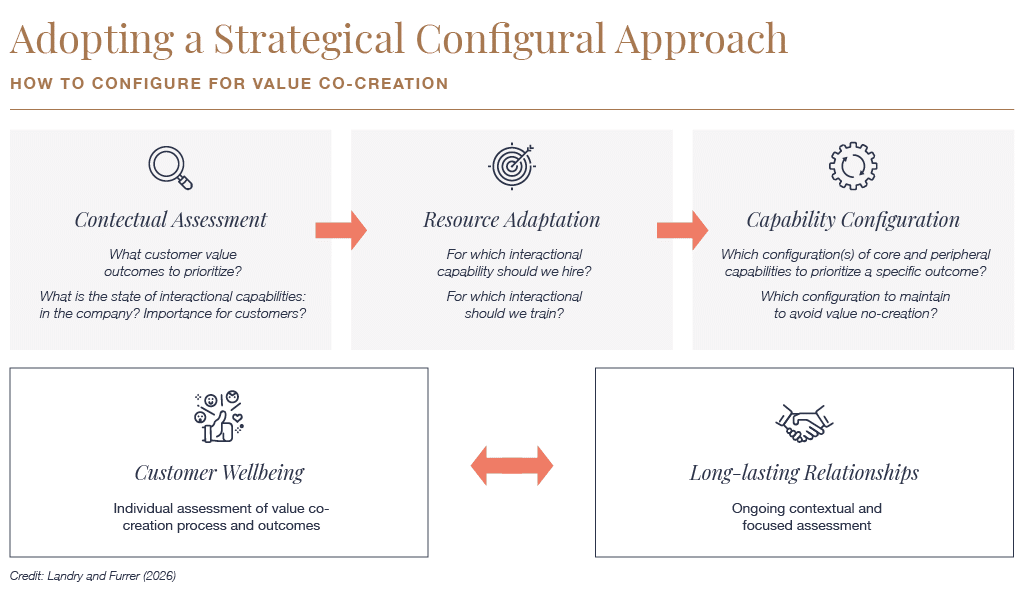
“The main contribution of our paper is that the interactional capabilities should not be considered individually. There should be a reflection within the organization about their configurations: which ones combine in a meaningful way to lead to a desired value outcome. That chart provides a roadmap to implementing our recommendations, ensuring that service managers invest time and money into things which are most relevant to their customers,” she notes.
“This begins with a thorough contextual assessment, the findings from which can be used to adapt and develop the firm’s existing capabilities, through employee training, service process, adaptation of the physical environment, among other service management practices.”
To ensure that these efforts are not in vain, the authors refer to the concept of value ‘no-creation’, which describes a situation where value is not destroyed but, at the same time, the outcomes are not those that were planned for.
While clearly preferable to destroying value, an outcome where no value is created for the customer leaves a firm with no forward momentum. Here again, this underlines the need for careful examination so that interactional capabilities can be combined in a way that leads to value enhancement for the customer. In other words, while certain configurations of interactional capabilities should be preferred to co-create a specific value outcome, service firms should still ensure the presence of other capabilities to avoid the non-realization of the same outcome for other customers who value different aspects of service interactions.
This is characterized by the bottom two boxes in our graphic above, relating to ‘assessment of value co-creation process and outcomes’ alongside ‘ongoing contextual and focused assessment’.
A (genuine) customer first approach
For Mikèle, the key takeaway for service managers is to place the customer at the center of their service strategy, and to make the optimization of service interactions a lead agenda item.

“This will establish the platform on which to build the organizational capabilities needed for value co-creation with their customers. We hope this paper will contribute to that process while also helping develop this configurational mindset and giving a more detailed understanding of concepts like value no-creation.”
“Ultimately, we’re also calling for a review of how customer experience is measured, expanding on the traditional metrics like satisfaction and loyalty and moving towards a more experiential framework that reflects the interactional aspects of the customer experience. Only by doing this can we generate a deeper understanding of how customers experience the service interactions that were designed for them,” she adds.

Such an approach connects with the other important research paper we’re featuring in this issue of The Insider, in which Dr. Evrim De Groot and fellow academics explore the notion of conspicuous consumption, highlighting the need for a thorough understanding of the customers.
If you find these articles of interest, make sure to check our "Research Insights" home page tab for more insights from our faculty team.
• Click the link below for more details about Mikèle's research paper:
Photo credits
Main image: jabkitticha/Getty
Customer journey: Supatman/Getty
Realize your leadership potential
As the world’s #3 ranked institution in our field, Glion offers the academic rigor and industry exposure you need to fulfil your professional dreams.