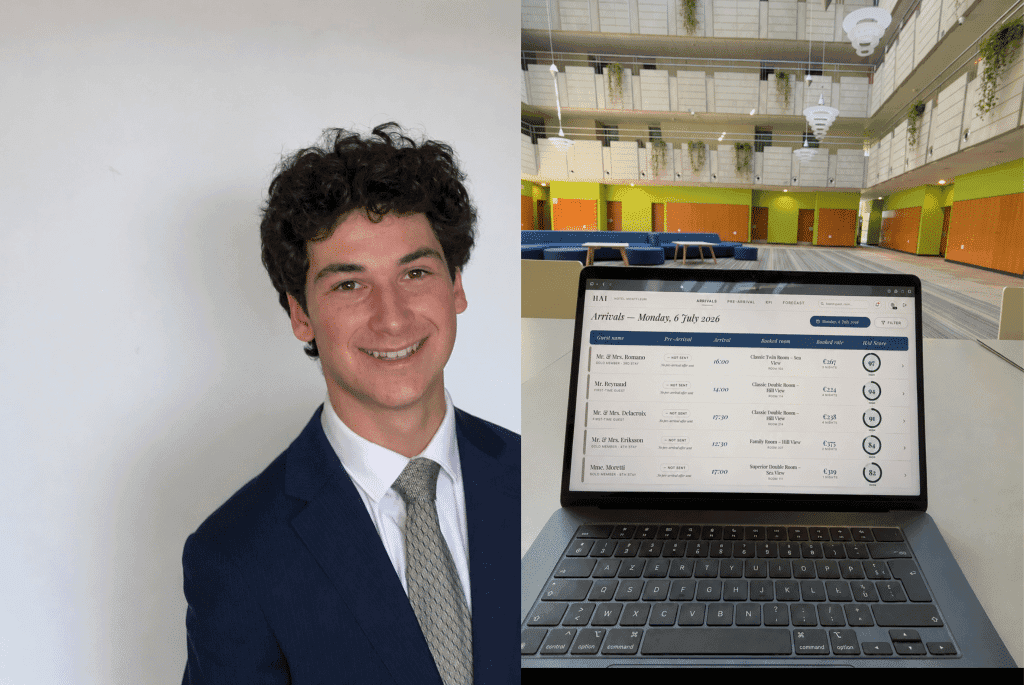
While Glion students are renowned for their entrepreneurial spirit and many hatch plans to start their own businesses, few achieve that ambition while still studying at the school.
That’s exactly what International Hospitality Business Bachelor student and Glion Ambassador Andrea Stanislas has done with the launch of HAI (Hospitality Artificial Intelligence), an AI-powered upselling platform that enables front office and revenue management teams to present personalized offers to guests at the right time.
Although years in the making, HAI found its perfect incubation environment at the school. Not only that, Glion alumni have been helping Andrea fine-tune the solution and even provided him with his first customers.
The Insider caught up with Andrea in between classes to find out more about the idea, the launched product and the path he has taken that led to this impressive moment.
Upselling that makes perfect sense
“The idea behind HAI is simple,” explains Andrea. “AI analyzes; the human decides. Before customers arrive, HAI can analyze available guest and hotel information, including reservation context, guest history and preferences and room categories. It then identifies the best offers and helps personalize them before check-in with the aim of focusing attention on the opportunities that actually make sense.
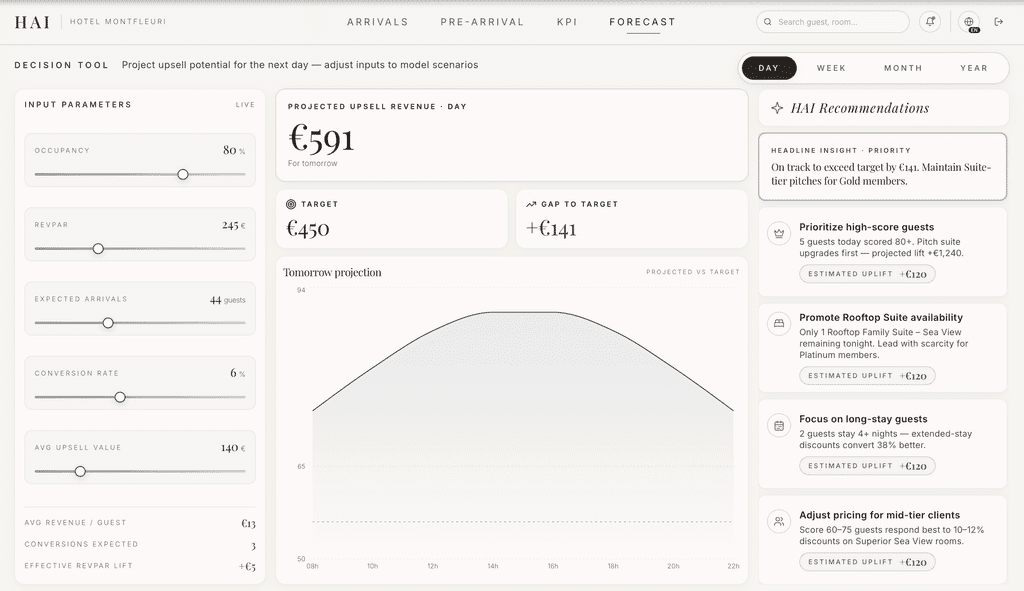
“When guests arrive, HAI turns the complexity into clear guidance for the receptionist, recommending the most relevant upsell, suggesting the right price and generating a bespoke way of offering it. In short, HAI does the analytical work so the receptionist can give their full attention to the guest standing in front of them.”
The platform is web-based and designed to connect directly with hotel PMS systems so teams do not need to create a parallel operational process. It can also track the commercial outcome of the upselling offers, including metrics such as conversion, revenue generated, average value and room category performance. That gives users a clearer view of what is working and where their attention can create the most value while also supporting future forecasting.
“The philosophy behind the product is that technology should reduce invisible complexity so hospitality professionals have more time and better information to create a human experience,” adds Andrea.
Deployment and development
Following the initial pilot work, the platform is now moving into deployment across three hotels: - Best Western Premier Montfleuri, Best Western Hotel Matisse and La Bastide du Calalou Hotel & Spa, BW Premier Collection.
“It’s great to see the platform move beyond conversations and prototypes into actual hotel operations,” says Andrea. “But deployment is just the beginning of the most important learning phase. Real hotel use will show where HAI creates the most value, how teams adopt it, which recommendations convert best and how the product should evolve from here.”
It’s a mature, grounded outlook from someone under the age of 21 and yet to graduate, especially at such an exciting time. But Andrea has been nurturing and developing the idea since the age of 16, gradually refining and testing elements of it in consultation with industry experts and in real-world settings. As a result, he understands there is a long way to go despite the obvious milestone of seeing the solution being deployed.
“I want to use the remaining part of my degree to keep learning, pressure-testing the company and building relationships with people who understand hospitality at a level I am still developing toward,” he adds. “Today, HAI is focused on accommodation upselling because it is a concrete problem with measurable value. But that is the first chapter, not the final destination.”
Finding the right problem to solve
Although the solution has launched – and Andrea sees it evolving further in future – the idea has been taking shape for more than four years.
“When I was 16, I watched a talk by Will Guidara about extraordinary hospitality,” he says. “One story stayed with me. Guests visiting New York had eaten at some of the city’s best restaurants, yet mentioned they regretted never having eaten one of the city’s famous hot dogs. A member of the restaurant team overheard them, went outside to buy one and turned a tiny observation into a memorable moment.
“That feeling of being understood before having to ask was what really struck me. I remember thinking that one of the most powerful things hospitality can provoke is the question: ‘How did they know’”
The original idea was to build something capable of learning guest preferences, habits and expectations so hotels could anticipate what might make a stay more personal. For nearly two years, Andrea developed that vision, researching all he could about artificial intelligence, hotel technology, customer relationship management, loyalty and personalization.
“The idea became richer, but also much too broad,” he said. “HAI touched almost every part of the guest journey – and I had not yet found the right first problem to solve.”
Testing times
Arriving at Glion proved a pivotal moment for HAI and Andrea. Not only did he achieve his ambition of attending the school, he was also surrounded by classmates, professors, visiting professionals and alumni who had real experience in hospitality.
Crucially, Glion helped Andrea understand that a vision is not the same thing as a good first product.
“I needed to find the right path for HAI and my studies gave me different ways to challenge the idea, from finance and strategy to human behaviour, marketing, operations and revenue,” he says. “I began using classes, assignments and conversations as opportunities to pressure test it.”
Having classmates and tutors as in-person sounding boards helped, as did learning about all the different aspects of hospitality. But the real eureka moment came when Andrea undertook his internship at the Hotel de Crillon in Paris (pictured below).
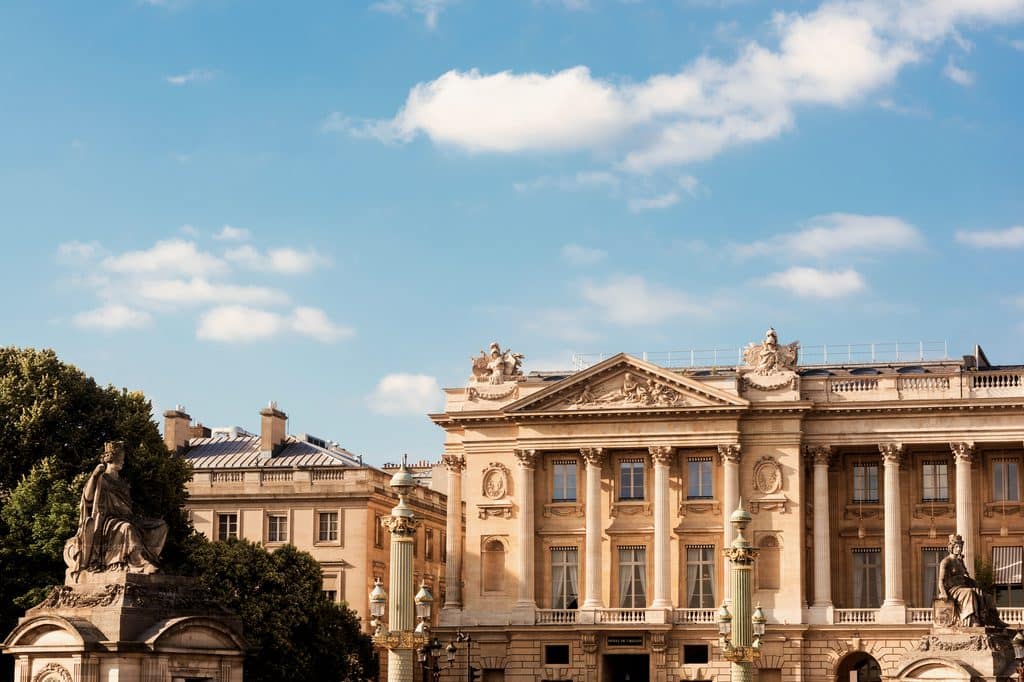
“It was there that I discovered room upselling,” he says. “And while it looks simple, doing it properly requires several decisions at once. And at the Hotel de Crillon end of the market, you can’t just treat it like a sales pitch – upselling needs to feel personal to the guest, natural and effortless.
“Over four months, I concentrated on refining room upselling and generated more than €35,000 in additional room revenue. But I kept coming back to one question: why should a receptionist spend time gathering information when AI could do it in seconds and allow the receptionist focus on the guest? And that’s when I knew what the focus should be for HAI.”
Clarity of vision
Instead of trying to solve personalization across the entire hotel journey, Andrea settled on a measurable problem with a clear user, workflow and economic outcome.
“I began presenting the idea to receptionists, revenue managers, hotel owners, consultants, investors and senior hospitality leaders,” he says. “I’ve pitched HAI nearly 100 times and those conversations have helped shape the product enormously.
“I’ve also started working with a CTO on the technical development, though I remain closely involved in the product logic, UX, hotel workflows, testing, positioning and commercial strategy. That’s because I want it to be technology shaped by how hotels actually work.”
With that as an aim, Andrea also took the wise decision to seek the advice – and in some case partner with – some of the hotel industry’s leading lights who also happen to be Glion alumni. Among these are hotel owner and former President of Best Western France Quentin Vandevyver, who Andrea has known since childhood, and Managing Director of Relais & Châteaux Anthony Torkington, who is a member of the HAI advisory board as well.
“Quentin became HAI’s first client and later joined the advisory board,” adds Andrea. “For me, the connection is especially meaningful because it represents what the Glion network can be: not networking for its own sake, but a relationship in which an alumnus challenges a student’s idea, becomes a client and then helps guide the company.”
Also on HAI’s advisory board are CEO of Digital Virgo Group Guillaume Briche, product engineering leader Troy Warkentin, CEO of HBI Overseas Clément Balladur and Co-Founder & CEO of Group 3S David Amiouni.
“The board is deliberately complementary,” says Andrea. “HAI is at the intersection of hospitality operations, technology, revenue, human behaviour and business, so I wanted the people around the company to reflect that complexity.”
Technology that enables hospitality
With the product now moving into hotel deployment, clients already signed up and an advisory board brimming with years of combined wisdom and experience, the future looks bright for Andrea and HAI. Even so, alongside his clear ambition for the platform, he retains a sense of perspective.
“I still have approximately a year and a half of studies at Glion,” he says. “I see that as one of HAI’s advantages: I can use the remaining part of my degree to continue developing the platform. Ultimately, my ambition is to graduate and for HAI to have grown alongside my education, with the school, its alumni and the industry acting as a continuous source of challenge and perspective.”
Andrea’s original idea was about recognition: the feeling that a hotel understands you, remembers you and anticipates what might make your stay better. That level of personalization relies on extraordinary professionals having enough time, experience and information to deliver it consistently.
“I believe technology can help more teams reach that standard without making hospitality less human. The technology should be practically invisible, absorbing complexity, connecting information and giving the team clarity while the people create the relationship and the emotion.
“If HAI can give hotel teams more time to understand the person in front of them, then technology is creating more space for hospitality to happen.”
• Click here to connect with Andrea on LinkedIn
Get on track for a bright future
As the world’s #3 ranked institution in our field, Glion offers the academic rigor and industry exposure you need to fulfil your professional dreams – whether you’re targeting a corporate career, the entrepreneurial life, or both!