
Every year at Glion, Bachelor students of many nationalities who choose the finance specialization learn to value real assets; and every year we notice the same moment of surprise.
Students first discover that a hotel valuation is a long chain of calculations which a spreadsheet, and now an AI tool, can perform in seconds. They then discover that the result depends almost entirely on a handful of numbers that no tool can give them with certainty: the room rate after renovation, the time a reopened hotel needs to fill its rooms, the cost of the works hidden behind old walls and the price at which a buyer might take the asset in ten years’ time.
Stephen Rushmore, whose income approach remains a reference point in hotel appraisal, acknowledged this when he wrote that the usual methods of projecting room rates “rely heavily on the experience and judgment of the appraiser” (Rushmore, 2001, p. 181). In that sense, the arrival of AI has made the technical part of the work cheap and left the judgment behind it more exposed than before.
This article summarizes a reflection we have been developing at Glion since October 2026, which brings together behavioral finance, the psychology of learning and the practice of hotel investment. A longer research paper, supported by interviews with professionals, will follow in 2027.
Two buildings, two kinds of uncertainty

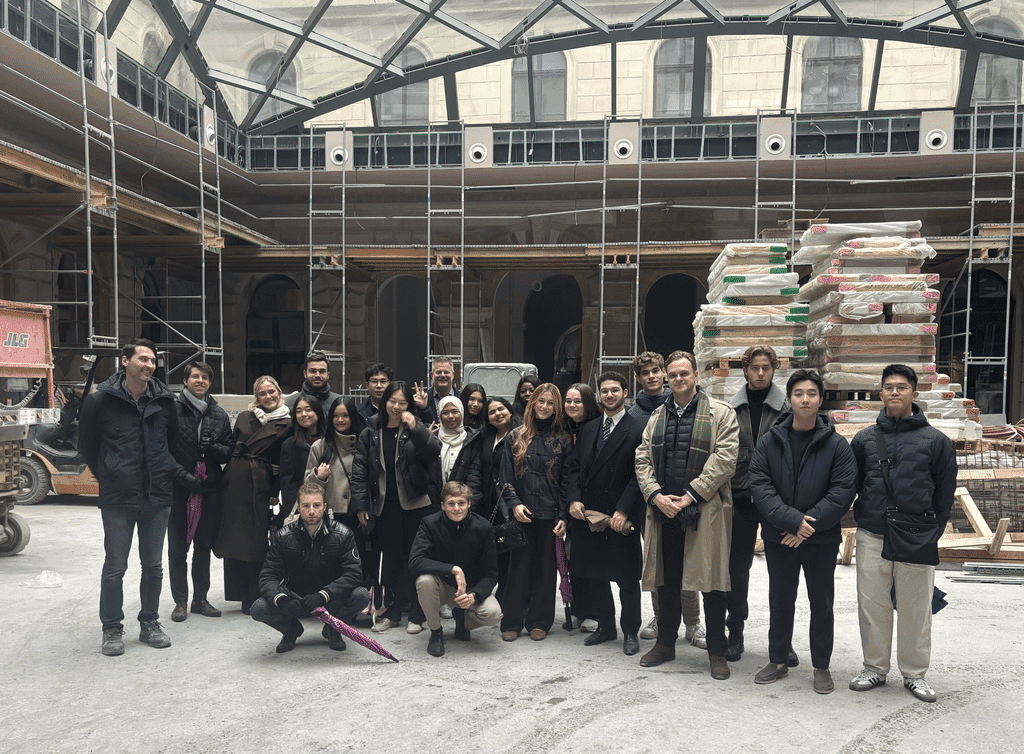
In November 2026 our students traveled to Budapest to work on two genuine mandates. The first owner had acquired more than 20,000 m² of prime real estate and had already started its renovation. The second, also the owner of a large property, had not yet started the works.
Both assets are likely to become mixed-use commercial real estate, in which a hotel shares the building with other uses, such as apartments, offices or retail. That makes the valuation harder still, because each component has its own market, its own comparables and its own way of influencing the others.
The two projects offer a useful contrast for teaching. In the first building, part of the uncertainty is already being resolved, as walls are opened, contractors submit their quotes and the real condition of the structure becomes visible. In the second, every figure is still a forecast.
Before visiting each building, our students recorded their key assumptions (the room rate, the occupancy, the speed of ramp-up, the capital expenditure and the exit yield), and they recorded them again after the visit. Comparing the two sets of numbers, and discussing why they moved, is one of the most instructive exercises we know. A site visit adds information, but a beautiful façade, a grand staircase or an enthusiastic owner can also add optimism, and students rarely notice which of the two has happened until they are asked to write it down.
Why the industry learns slowly
It would be easy to assume that experience corrects these errors over time. The research suggests that it does so only partly. Kahneman and Klein (2009, p. 523) showed that intuition can be trusted only where professionals receive rapid and clear feedback on their judgments, and that for long-term financial decisions the feedback is “delayed, sparse, and ambiguous.” A hotel investor may wait five to ten years to learn whether an assumption was right and by then the result is mixed with the market cycle, the operator’s performance and luck.
The institutions of the industry do not always help. When Hodari and Samson (2014) interviewed 28 consultants, lenders, owners, operators, advisers and academics about hotel feasibility studies, they found that studies are rarely revisited once financing is secured and that lenders keep no record of which providers were right. Asked why the studies had not changed in years, one consultant answered simply, “Because no one has asked us to change anything” (p. 107).
More recently, a study of 4,931 US commercial mortgage loans made between 2010 and 2022 found that 46% of hotel appraisals exceeded the purchase price by more than 5%, against 21% for retail properties (Singh et al., 2026). Having said that, a gap between a valuation and a price is not in itself proof of bias, since prices also reflect bargaining, timing and financing, and many of the valuers whose work we discuss are colleagues from whom we and our students learn a great deal.
The point is rather that the conditions in which hotel professionals work make it difficult to learn from experience, so that years of practice may build confidence faster than they build accuracy. A 20-year study of German financial forecasters points in the same direction, as their 90% forecast ranges contained the actual outcome only about 40% of the time, with no improvement over two decades (Merkle & Schreiber, 2025).

The biases our students will encounter
For our students in Budapest, three biases are particularly relevant. The first is anchoring. Tversky and Kahneman (1974) showed that people adjust too little from a starting figure, even an irrelevant one, and the valuation profession is no exception.
In a study published in 2026, 170 real estate professionals in Poland, nearly half of them licensed appraisers, valued the same apartment from an identical description, except that its last sentence mentioned a proposed price of either PLN 139,000 or PLN 295,000 (five experts who read the description without that sentence had valued it at about PLN 217,000 on average).
Those who saw the higher figure arrived on average at about PLN 268,000, against about PLN 196,000 for those who saw the lower one, so that nearly half of the gap between the two suggested prices found its way into their valuations, with their years of experience making no measurable difference to the accuracy of their estimates (Kazak et al., 2026).
Earlier evidence from the United States shows how this happens in practice, as appraisers who knew the contract price chose and adjusted their comparables toward it and valued the same homes about 4% higher than before the contract was signed (Eriksen et al., 2020). In a real mandate, the anchor may be the price the owner paid, the figure in an earlier report or simply the number the owner hopes to hear.
The second is motivated reasoning, which Kunda (1990) described as the tendency to search for, and weigh, evidence in favor of the conclusion we would like to reach. Our students work for real owners whom they meet, respect and naturally wish to please. It makes sense that the desire to deliver good news can quietly shape an occupancy forecast or a renovation budget, and recognizing this pressure is part of their professional education.
A related distinction is useful here. Market value is the price that could reasonably be expected in the market, whereas investment value is the value of a property to a particular owner on that owner’s own criteria, and the European Valuation Standards require a report to say which of the two it presents (TEGoVA, 2025). Knowing for whom, and on what basis, a figure is produced is the first protection against confusing the two.
The third bias is optimism about time and cost, which Kahneman and Lovallo (1993) linked to an ‘inside view’ that focuses on the plan at hand instead of the record of similar projects. A renovation succeeds only if every stage does, and people tend to overestimate the chance that a long chain of likely steps will all go right (Tversky & Kahneman, 1974). Indeed, the building that has already started its works will show our students, quote by quote, how far the early budget moves once the walls are opened.
Market evidence can help to discipline such forecasts. In a study of 3,494 new hotels opened in the United States between 2006 and 2009, it took seven to eight quarters for new hotels to reach the occupancy of comparable existing hotels in their markets, and independent hotels needed until their fifth year to match their competitors’ revenue per available room (Enz et al., 2014).
A renovated European hotel with an existing reputation may move faster, but a valuation that assumes a much faster ramp-up should be able to explain why. Rushmore (2001, p. 433) noticed the same tendency with some humor, observing that developers typically specify the earliest possible opening date, “hoping to be the early bird.”
What AI changes
AI tools can now draft a market overview, a financial model or even a valuation report in minutes, although the evidence on their usefulness is mixed. In a preregistered experiment with 758 consultants at Boston Consulting Group, those using GPT-4 on tasks well suited to the tool produced work of markedly higher quality; yet on a business case designed so that the model would point to the wrong answer they were right only 60% to 71% of the time, against 84.5% for colleagues working without it, and their recommendations were judged more persuasive whether they were right or wrong (Dell’Acqua et al., 2026). The models also carry biases of their own.

Nine large language models (LLMs) from four providers moved their answers toward a high or a low figure suggested in the question, and an instruction to ignore that figure did not remove the effect (Lou & Sun, 2026). In other words, a student who types the owner’s hoped-for price into an AI tool may receive that price back in the form of a polished report.
The same studies suggest a more fruitful use. When the models were given both a high and a low figure, or both the gain and the loss framing of the same problem, their answers came close to the unbiased ones (Lou & Sun, 2026; Tait & Pisaneschi, 2026). Used as a challenger that is deliberately given both sides of the evidence, AI can help a team question its own base case, and this is how we encourage our students to use it.
Teaching judgement
The research on debiasing is more modest than many training programs suggest, and a single workshop on anchoring will not remove investment errors. What seems to help is repetition with feedback on real cases, which is why we build our teaching around a few simple habits.
Our students write down their key assumptions with a source, a plausible range and a date. They compare each forecast with the record of similar projects, which Kahneman and Lovallo (1993) call the outside view. Before committing to a value, they run a pre-mortem (Klein, 2017), imagining that the investment has disappointed five years from now and explaining why.
Above all, they return to their forecasts when new information arrives, which is precisely what the industry so rarely does (Hodari & Samson, 2014). The two Budapest projects give us an unusual opportunity in this respect, since the renovation in progress will reveal, month after month, how close our students’ first estimates of cost and time really were.
These habits have something in common, which is the willingness to treat one’s own judgment as something that can be examined and improved over a career. In that sense, learning to recognize our biases is as much a matter of humility and self-awareness as of finance, and it is perhaps the most valuable thing we as lecturers can help our students carry into their professional lives, whether they go on to invest their own capital or to advise those who do.
We will continue this work in 2027 with interviews of investors, lenders and valuers on how they learned to recognize their own biases, and we look forward to sharing the results.
A big thank you to the owners of both Budapest properties for opening their doors to our students, and to Attila Hegedus and Bořivoj Vokřínek for their valuable contributions to this project.
Click for list of academic references
Dell’Acqua, F., McFowland, E., Mollick, E., Lifshitz, H., Kellogg, K. C., Rajendran, S., Krayer, L., Candelon, F., & Lakhani, K. R. (2026). Navigating the jagged technological frontier: Field experimental evidence of the effects of artificial intelligence on knowledge worker productivity and quality. Organization Science. https://doi.org/10.1287/orsc.2025.21838
Enz, C. A., Peiró-Signes, Á., & Segarra-Oña, M. (2014). How fast do new hotels ramp up performance? Cornell Hospitality Quarterly, 55(2), 141-151.
Eriksen, M. D., Fout, H. B., Palim, M., & Rosenblatt, E. (2020). Contract price confirmation bias: Evidence from repeat appraisals. The Journal of Real Estate Finance and Economics, 60(1), 77- 98.
Hodari, D., & Samson, D. (2014). Settling for less: The institutionalization of the hotel feasibility study. The Journal of Hospitality Financial Management, 22, 97-110.
Kahneman, D., & Klein, G. (2009). Conditions for intuitive expertise: A failure to disagree. American Psychologist, 64(6), 515-526.
Kahneman, D., & Lovallo, D. (1993). Timid choices and bold forecasts: A cognitive perspective on risk taking. Management Science, 39(1), 17-31.
Kazak, J. K., Zarębska, W., Sadowski, A., & Kamińska, J. A. (2026). The anchoring effect in real estate decisions. Real Estate Management and Valuation, 34(1), 53-62. https://doi.org/10.2478/remav-2026-0005
Klein, G. (2017). Sources of power: How people make decisions (20th anniversary ed.). MIT Press.
Kunda, Z. (1990). The case for motivated reasoning. Psychological Bulletin, 108(3), 480-498.
Lou, J., & Sun, Y. (2026). Anchoring bias in large language models: An experimental study. Journal of Computational Social Science, 9, Article 11.
Merkle, C., & Schreiber, P. (2025). Learning to be overprecise. Journal of Business Economics, 95, 467-497.
Rushmore, S. (2001). Hotel investments handbook 2002. HVS International.
Singh, A., O’Neill, J. W., & Liu, P. (2026). Is lodging appraisal bias different from other commercial real estate sectors? International Journal of Hospitality Management, 135, Article 104609.
Tait, J., & Pisaneschi, B. (2026). Managing LLM bias in investing: From detection to mitigation. CFA Institute Research and Policy Center.
TEGoVA. (2025). European valuation standards 2025 (10th ed.). The European Group of Valuers’ Associations.
Tversky, A., & Kahneman, D. (1974). Judgment under uncertainty: Heuristics and biases. Science, 185(4157), 1124-1131.
Photo credits
Main image: metamorworks/Getty
Urban cityscape: primeimages/Getty
Be wise, specialize
Asset Development and Finance is one of three academic specializations available to students of our Bachelor’s in International Hospitality Business. Click the link to discover more.